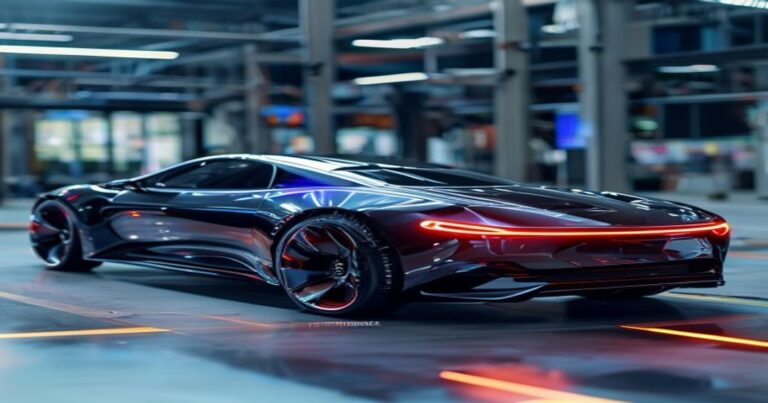
The internal combustion engine defined the 20th century, but code is defining the 21st. We are witnessing a fundamental shift where a car’s value is no longer measured by its horsepower or leather stitching, but by its computational overhead.
Modern vehicles are essentially high-performance data centers on wheels. Between sensor fusion, predictive maintenance, and the race for Level 4 autonomy, AI isn’t just an add-on feature—it’s the new chassis. Here is how artificial intelligence is dismantling and rebuilding the automotive industry from the assembly line to the asphalt.
The End of ‘Guesswork’ Maintenance
For decades, vehicle maintenance was reactive. You waited for a light to pop up on the dashboard or for a strange grinding sound to emerge from the wheel well. AI has flipped this script through predictive analytics. By processing real-time telemetry from thousands of sensors, manufacturers can now predict a component failure before it happens.
Digital Twins and Real-Time Diagnostics
Companies like BMW and Tesla use “Digital Twins”—virtual clones of physical vehicles. Every time a car hits a pothole or experiences an engine spike, that data is fed back to the twin. If the AI detects a pattern across 50,000 vehicles that suggests a fuel pump might fail at 40,000 miles, the manufacturer can issue a software patch or a proactive service alert. This shift from reactive to proactive service reduces warranty costs for brands and saves owners from catastrophic breakdowns.
The Vision Problem: Why Level 5 is So Hard
We’ve been promised fully autonomous cars “next year” for about a decade. The delay isn’t due to a lack of processing power; it’s the “Long Tail” of edge cases. AI excels at the 99% of driving that is boring and predictable. It struggles with the 1%—the chaotic human element.
Current ADAS (Advanced Driver Assistance Systems) use a combination of Computer Vision and Neural Networks to categorize objects. Think of it as a constant game of ‘What is this?’. Is that a plastic bag blowing in the wind or a small child? Is that a reflection on a wet road or a deep puddle? To solve this, companies are moving toward End-to-End AI, where the car doesn’t just follow a set of “if-then” rules written by engineers, but learns to drive by observing millions of hours of human behavior.
“The challenge isn’t teaching a car to drive; it’s teaching a car to negotiate. Driving is a social contract, and AI is just now learning how to read the room.”
Generative AI in the Design Studio
AI’s impact isn’t limited to the driving experience; it’s radically shortening the R&D cycle. Traditionally, designing a new car body took years of clay modeling and wind tunnel testing. Today, designers use generative AI to optimize aerodynamics and structural integrity in seconds.
- Weight Reduction: AI algorithms can design brackets or engine components that use 30% less material while maintaining the same strength.
- Rapid Prototyping: Instead of drawing ten versions of a headlight, designers feed parameters into a model that generates 1,000 aerodynamically viable options.
- Supply Chain Resilience: AI models now predict shipping bottlenecks and raw material shortages weeks in advance, allowing factories to pivot production schedules without stopping the line.
The Cockpit as a Personal Assistant
The infotainment system is the next major battleground. We are moving away from clunky touchscreens toward Natural Language Processing (NLP) that actually works. Mercedes-Benz, for instance, is integrating ChatGPT-style interfaces to make voice commands feel like a conversation rather than a struggle with a 2005-era GPS.
The car will soon know your schedule, your preferred cabin temperature, and your stress levels. If the internal cameras detect a drowsy driver, the AI can adjust the lighting, play upbeat music, or suggest a nearby coffee shop. This isn’t just about luxury; it’s about creating a biometric feedback loop that keeps drivers safe.
Key Takeaways:
- Predictive Maintenance: AI reduces downtime by identifying mechanical failures before they occur.
- Edge Cases: The path to full autonomy relies on solving the “1%” of unpredictable human behavior.
- Generative Design: AI is making cars lighter, safer, and faster to manufacture.
- Personalization: The cabin is evolving into an AI-driven living space that monitors driver health and preferences.
The automotive industry is no longer about bending metal; it’s about managing data. For manufacturers, the goal is to become software companies. For consumers, the result is a vehicle that gets smarter every time it pulls out of the driveway. The hardware is just the vessel; the intelligence is the product.